Commercial Roofing Cleveland Ohio: Complete Guide for Properties
Commercial Roofing in Cleveland Ohio: Systems, Costs & Expert Tips
If you own or manage a commercial property in Cleveland, Ohio, your roof is doing far more than keeping rain out. It’s protecting your inventory, your equipment, your tenants, and your bottom line — every single day, through every storm, freeze, and thaw cycle that Northeast Ohio delivers without mercy.
Commercial roofing in Cleveland, Ohio is a specialized discipline that demands materials, installation techniques, and maintenance strategies built specifically for the demands of large-scale roofing systems and the punishment of the Great Lakes climate. At Eagle JA Roofing LLC, we’ve worked with business owners, property managers, warehouse operators, and facility directors across Cuyahoga County — and we’ve seen firsthand what happens when commercial roofing decisions are made without the right information.
This complete guide covers everything you need to know: roofing system types, cost factors, warning signs, repair versus replacement decisions, and how to choose a commercial roofing contractor in Cleveland you can trust. Whether you’re dealing with an active leak, planning a scheduled replacement, or simply trying to understand your options before budgeting season — this is the resource that answers your questions clearly, honestly, and completely.
Understanding Commercial Roofing
Commercial roofing is fundamentally different from residential roofing — not just in scale, but in system design, material requirements, drainage engineering, load considerations, and installation complexity. Understanding those differences is the first step toward making smart decisions about your property.
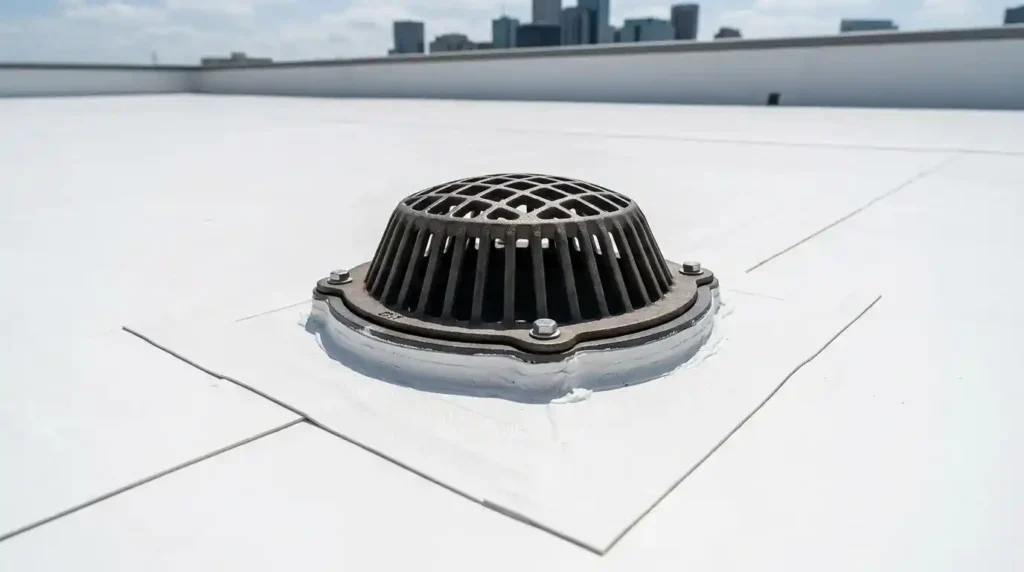
What Makes Commercial Roofing Different?
Residential roofs are typically steep-sloped systems designed to shed water quickly through gravity. Commercial roofing systems, by contrast, are most commonly low-slope or flat — meaning they rely on engineered drainage systems, membrane waterproofing, and precise installation to manage water effectively rather than simply pitching it off.
This flat or low-slope design introduces specific challenges:
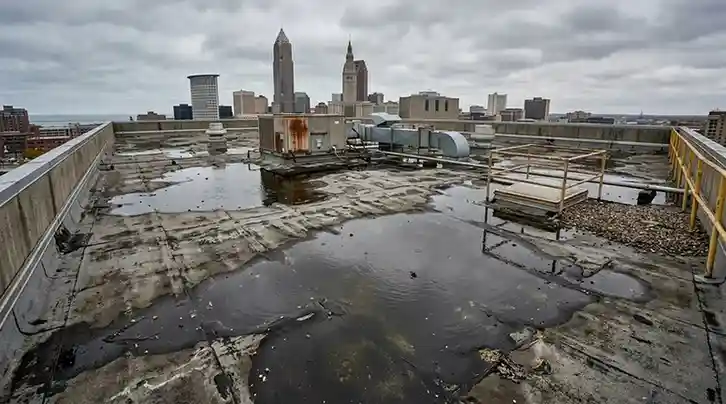
- Ponding water — water that pools on the surface after rain and doesn’t drain within 48 hours — accelerates membrane deterioration and creates leak pathways that steep roofs simply don’t experience.
- Larger surface areas mean more linear feet of seaming, flashing, and penetration points — every one of which is a potential failure location if not installed and maintained correctly.
- Mechanical equipment — HVAC units, exhaust systems, conduit runs, and rooftop skylights — creates dozens of roof penetrations that require perfect waterproofing seals maintained over decades.
For commercial properties in Cleveland, Ohio, these challenges are compounded by weather conditions that rank among the most demanding in the Midwest. Snow loads, ice formation, freeze-thaw cycling, and high-wind lake-effect events create roofing stresses that require both superior materials and expert installation to manage reliably over the long term.
Who Needs Commercial Roofing Solutions?
Commercial roofing in Cleveland serves a wide range of property types and industries, including:
- Office buildings and professional centers
- Warehouses and distribution facilities
- Retail centers and strip malls
- Manufacturing and industrial properties
- Multi-family apartment buildings
- Schools, churches, and healthcare facilities
- Restaurants and hospitality properties
Each building type has specific roofing requirements based on occupancy, load, drainage volume, equipment footprint, and energy performance targets. A one-size-fits-all approach to commercial roofing doesn’t work — and any contractor who treats your warehouse the same as a neighboring office building isn’t giving your property the analysis it deserves.
Types of Commercial Roofing Systems
Choosing the right roofing system for your Cleveland commercial property is one of the most consequential decisions you’ll make as a building owner or facility manager. Each system has specific advantages, performance characteristics, cost profiles, and ideal use cases. Here’s what you need to know about each major option:
TPO Roofing (Thermoplastic Polyolefin)
TPO roofing is currently the most widely installed commercial roofing system in North America — and for good reason. TPO membranes offer an outstanding combination of energy efficiency, durability, ease of installation, and cost-effectiveness that makes them the leading choice for most flat and low-slope commercial buildings in Cleveland, Ohio.
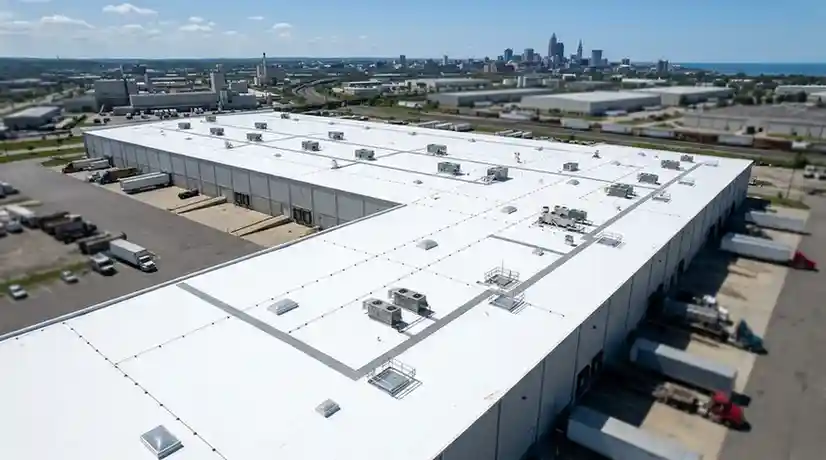
Key characteristics of TPO roofing:
- Energy efficiency — TPO’s white reflective surface reflects solar radiation rather than absorbing it, reducing rooftop heat gain and lowering cooling costs significantly during Cleveland’s warm months
- Weld strength — TPO seams are heat-welded to create bonds that are actually stronger than the membrane itself, eliminating the seam failures that plagued older adhesive-based systems
- Flexibility — TPO remains pliable across a wide temperature range, making it highly resistant to the cracking and brittleness that Cleveland’s extreme cold creates in less flexible membrane systems
- Lifespan — properly installed TPO roofing systems typically last 15 to 30 years depending on membrane thickness and maintenance frequency
- Cost — TPO is generally the most cost-effective single-ply membrane option, offering strong long-term value relative to upfront installation cost
Best for: Office buildings, warehouses, retail centers, and any Cleveland commercial property where energy efficiency and value are primary priorities.
Quick Answer: TPO roofing is the most popular commercial roofing system in Cleveland because it combines strong weather resistance, energy-reflecting performance, and cost-effectiveness — making it ideal for Northeast Ohio’s climate demands.
EPDM Roofing (Ethylene Propylene Diene Monomer)
EPDM — commonly called “rubber roofing” — is one of the most proven and long-standing commercial roofing systems available, with a track record spanning more than 50 years of real-world installation across North America.
Key characteristics of EPDM roofing:
- Exceptional cold-weather performance — EPDM remains highly flexible even in extreme low temperatures, making it particularly well-suited to Cleveland’s winters where membrane brittleness is a serious concern
- UV resistance — EPDM’s carbon black formulation provides outstanding resistance to UV degradation without requiring reflective coatings
- Lifespan — quality EPDM installations routinely achieve 20 to 30 years of service life with proper maintenance
- Repair simplicity — EPDM is one of the easiest commercial roofing membranes to repair, with straightforward patch systems that don’t require specialized equipment
- Cost — EPDM is competitively priced and represents strong long-term value, particularly when lifecycle cost is calculated against its extended lifespan
The limitation worth knowing: Standard black EPDM absorbs heat rather than reflecting it. For Cleveland commercial properties in buildings with high cooling loads or energy efficiency goals, white-coated EPDM or TPO may be the more appropriate choice. White EPDM membranes are available and close this gap significantly.
Best for: Warehouses, manufacturing facilities, older commercial buildings undergoing re-roofing, and properties where cold-weather membrane flexibility is a priority.
PVC Roofing (Polyvinyl Chloride)
PVC roofing is the premium single-ply membrane option — delivering the highest chemical resistance, the strongest welded seams, and the best fire resistance of any membrane system currently available for commercial roofing in Cleveland, Ohio.
Key characteristics of PVC roofing:
- Chemical resistance — PVC is the only commercial membrane system that resists damage from oils, fats, grease, and industrial chemicals, making it the mandatory choice for restaurants, food processing facilities, and commercial kitchens with rooftop exhaust systems
- Weld strength — like TPO, PVC seams are heat-welded and create bonds of exceptional strength, but PVC welds are generally considered the most reliable and consistent of any membrane system
- Fire resistance — PVC carries the highest fire ratings of any single-ply commercial membrane, a critical consideration for properties in certain occupancy categories
- Energy efficiency — PVC’s white surface provides strong solar reflectance similar to TPO
- Lifespan — quality PVC installations typically last 20 to 30 years, with some installations reaching beyond 30 years in favorable conditions
- Cost — PVC carries the highest upfront cost of the three primary single-ply systems, but its performance advantages justify the investment for appropriate applications
Best for: Restaurants, food service facilities, industrial properties with chemical exposure, healthcare facilities, and any Cleveland commercial property where chemical resistance or maximum fire rating is a requirement.
Metal Roofing
Commercial metal roofing is the premium long-duration solution for commercial properties that prioritize absolute longevity, maximum weather resistance, and the lowest possible lifetime maintenance cost.
Key characteristics of commercial metal roofing:
- Lifespan — commercial metal roofing systems routinely last 40 to 60 years, and some well-maintained steel and aluminum systems exceed 70 years of service — dramatically outlasting any membrane system
- Snow performance — metal roofing sheds snow loads naturally and resists ice formation better than any flat membrane system, making it particularly valuable for Cleveland commercial properties with high snow load exposure
- Wind resistance — standing seam metal roofing systems achieve among the highest wind uplift ratings available in commercial roofing
- Energy efficiency — metal roofing’s reflective properties and thermal mass management significantly reduce HVAC loads
- Sustainability — metal roofing is fully recyclable at end of life, making it the most environmentally sustainable commercial roofing option available
- Cost — metal roofing carries the highest upfront installation cost of any commercial roofing system, but its extended lifespan means the lowest cost per year of service over the building’s life
Best for: Manufacturing facilities, large warehouses, churches, schools, and any Cleveland commercial property where long-term ownership and minimal lifecycle maintenance cost are the primary investment criteria.
How to Choose the Right Commercial Roof
Selecting the right commercial roofing system for your Cleveland property isn’t a decision that should be made based on price alone — or based on what the contractor happens to have in stock. Here’s the decision framework that professional facility managers and experienced commercial property owners use:
Evaluate Your Building’s Specific Requirements
Ask these questions first:
- What is the roof’s current slope? (Flat or low-slope roofs have different system options than sloped sections)
- What is the total rooftop equipment footprint? (More penetrations = more sealing requirements)
- What are the drainage patterns and current drainage infrastructure?
- What is the building’s occupancy type and are there chemical exposure concerns?
- What is the building’s energy performance target?
Match Material to Climate
In Cleveland, Ohio, the right commercial roofing system must perform reliably across temperature swings from -10°F to 90°F+, under heavy snow loads, through repeated freeze-thaw cycles, and against sustained high-wind events. Not every material performs equally well under all of these conditions simultaneously.
TPO and EPDM are the most climate-appropriate membrane systems for most Northeast Ohio commercial properties. Metal roofing is the premium option where budget allows. PVC adds value where chemical exposure or fire rating is a specific requirement.
Factor in Lifecycle Cost — Not Just Upfront Cost
A commercial roof that costs $60,000 to install but lasts 30 years with minimal maintenance costs less over its lifetime than a $40,000 system that requires significant maintenance investment every five years and needs replacement in 15. Always calculate cost per year of service when comparing commercial roofing options — not just the installation quote.
Signs Your Commercial Roof Needs Attention
How do you know when your commercial roof in Cleveland needs professional evaluation? Don’t wait for water to appear on the floor of your warehouse. These are the warning signs that require immediate action:
Active or Recent Leaks
Any evidence of water intrusion — ceiling stains, wet insulation, mold growth, or active dripping during or after rain — is a clear signal for immediate professional assessment. Commercial roof leaks almost never resolve themselves and always worsen with time.
Direct Answer: If you see ceiling stains, damp spots on the roof surface, or bubbling in your membrane, call a commercial roofing inspector today. Waiting makes every leak more expensive.
Ponding Water
Water that remains pooled on your roof surface 48 hours after rainfall is not a cosmetic issue — it’s a structural and waterproofing concern. Ponding water adds weight load to the roof structure, accelerates membrane deterioration, and increases freeze-thaw stress in winter. If your Cleveland commercial roof consistently ponds water, drainage system evaluation and possible correction is needed before the next heavy rain cycle.
Membrane Blistering or Bubbling
Blistering, bubbling, or raised sections in a roofing membrane indicate moisture trapped between membrane layers or between the membrane and insulation. This moisture compromises the membrane’s adhesion and integrity and creates pathways for further water intrusion. Blistering is an early-stage problem that becomes significantly more expensive if ignored.
Visible Flashing Damage
Flashing at parapet walls, HVAC curbs, skylights, drains, and roof penetrations is the most common leak entry point on commercial roofing systems. Visible separation, corrosion, lifting, or gaps in any flashing component require immediate professional repair.
Interior Energy Cost Increases
An unexplained increase in heating or cooling costs without a change in occupancy or equipment often indicates roofing insulation compromise — wet or compressed insulation from undetected moisture intrusion. This is one of the most common hidden signs of commercial roof deterioration in Cleveland, Ohio buildings.
Roof Age Approaching System Lifespan
If your commercial roof is approaching the end of its expected service life — typically 15 to 20 years for older membrane systems — proactive evaluation and planning is far more cost-effective than emergency response after failure. Schedule a professional commercial roof inspection before the system fails, not after.
Commercial Roof Repair vs. Replacement
One of the most common and most consequential questions Cleveland commercial property owners face is whether to repair their existing roof or invest in a complete replacement. Here is the honest, experience-based framework for making that decision correctly:
When Repair Is the Right Answer
Repair is appropriate when:
- The roofing system is less than 10 to 15 years old with substantial remaining lifespan
- Damage is isolated to specific, clearly defined areas with the surrounding membrane in sound condition
- The leak source is identified and traceable to a specific failure point (flashing, penetration seal, localized membrane damage)
- Repair cost represents less than 25 to 30 percent of full replacement cost
- The underlying insulation and roof deck are dry and structurally sound
In these situations, targeted professional repair by a qualified commercial roofing contractor extends the roof’s service life cost-effectively and defers replacement to an appropriately scheduled future date.
When Replacement Is the Right Answer
Replacement becomes the correct decision when:
- The roofing system is at or beyond its expected service life
- Leaks are multiple, recurring, or widespread across the roof surface
- Moisture has compromised the insulation system — wet insulation must be replaced along with the membrane
- Repair costs are accumulating to 40 percent or more of replacement cost without resolving the underlying problem
- The roof deck has sustained moisture damage requiring structural repair
- Energy performance has degraded significantly due to insulation compression or deterioration
Direct Answer: If your commercial roof is leaking in multiple locations and is more than 15 years old, replacement is almost always more cost-effective than continued repair. The math changes dramatically when you factor in recurring repair costs, interior damage risk, and business disruption.
Eagle JA Roofing LLC provides honest repair vs. replacement assessments for every commercial property in Cleveland we inspect — giving you the real numbers to make the right decision for your budget and your building.
Commercial Roofing Cost Factors
“How much does commercial roofing cost in Cleveland, Ohio?” This is the question every property owner and facility manager asks — and the honest answer is that no contractor can give you an accurate number without first inspecting your roof. Here are the factors that most significantly influence commercial roofing costs:
Roof Size and Square Footage
Commercial roofing is priced by the roofing square (100 square feet of surface area). Larger roofs require more material and more labor hours. A 10,000 square foot commercial roof will cost proportionally more than a 5,000 square foot system — though larger projects often achieve slightly better per-square pricing due to installation efficiency.
Roofing System Type
Material selection is one of the largest cost variables in commercial roofing:
| Commercial Roofing System | Typical Installed Cost (Per Sq Ft) | Average Lifespan | Best For |
|---|---|---|---|
| TPO Roofing | $5.50 – $9.00 | 15–30 Years | Energy-efficient flat commercial roofs |
| EPDM Roofing | $5.00 – $8.50 | 20–30 Years | Budget-friendly, durable rubber roofing |
| PVC Roofing | $7.00 – $12.00 | 20–30 Years | Restaurants, industrial & chemical-resistant applications |
| Metal Roofing | $10.00 – $20.00+ | 40–60+ Years | Maximum durability and long-term value |
Note: These are general ranges. Actual costs for your Cleveland commercial property depend on roof complexity, current system condition, deck repairs needed, and local labor market factors. Always obtain a written, itemized estimate before any commitment.
Roof Accessibility and Complexity
A simple, open flat roof with minimal equipment is the fastest and least costly to work on. A roof crowded with HVAC units, conduit runs, skylights, drains, parapet walls, and multiple penetrations requires significantly more labor time for proper flashing and sealing — and that additional time reflects in the project cost.
Tear-Off and Disposal
If the existing roofing system must be removed before new installation — which is required when insulation is wet, the deck needs repair, or local building codes limit the number of allowable roof layers — tear-off and disposal adds cost to the project. This is non-negotiable when structural integrity requires it, and any contractor who layers new materials over a failed wet system to save money is creating a problem, not solving one.
Deck Repairs
During tear-off, damaged or deteriorated roof decking discovered beneath the existing system must be repaired or replaced before new roofing is installed. The extent of deck repair needed is often not fully known until the existing system is removed — which is why reputable commercial roofing contractors in Cleveland build a contingency provision into written estimates and communicate transparently about any additional scope discovered during the project.
Labor and Installation Quality
Skilled, certified commercial roofing labor is not an area to minimize cost. Improper installation of commercial membrane systems — particularly seam welding, flashing fabrication, and drain integration — creates failure points that typically appear within two to five years and cost more to remediate than the original labor savings. Quality installation from a licensed commercial roofing contractor is the investment that makes every other material and system choice actually perform as intended.
Commercial Roofing Process
Understanding what happens during a professional commercial roof installation in Cleveland removes uncertainty and helps you plan appropriately for project timeline and business operations impact.
Step 1 — Initial Inspection and Assessment
Every commercial roofing project begins with a thorough professional inspection of the existing system. A qualified commercial roofing contractor evaluates membrane condition, insulation integrity (often using infrared scanning or core sampling to detect hidden moisture), deck soundness, drainage performance, flashing status, and equipment integration. This assessment is the foundation of every honest recommendation and accurate project estimate.
Step 2 — Written Estimate and Scope Definition
Following inspection, your contractor provides a detailed written estimate that defines the full project scope: system type, material specifications, square footage, tear-off requirements, deck repair allowance, project timeline, warranty terms, and total itemized cost. Review this document carefully. Ask questions about anything unclear before signing.
Step 3 — Material Selection and Procurement
Once the project is approved, materials are ordered to specification. For commercial roofing projects in Cleveland, lead times on specialty materials can range from a few days to several weeks depending on system type and current supply conditions. Your contractor communicates material arrival timing as part of the project schedule.
Step 4 — Site Preparation and Tear-Off
On project commencement, the site is prepared: equipment is protected, drainage systems are staged, and existing roofing materials are removed. Tear-off is conducted systematically with attention to proper deck exposure and immediate protection of any exposed areas from weather before new materials are installed.
Step 5 — Deck Repair and Preparation
With the existing system removed, the deck is inspected in detail. Any damaged, wet, or structurally compromised decking is repaired or replaced. Drains are cleaned and inspected. The surface is prepared to the specification required for the new roofing system’s installation protocol.
Step 6 — New System Installation
The new commercial roofing system is installed in sequence according to manufacturer specifications and project design — beginning with any required insulation layers, followed by the primary membrane system, completed with all flashing fabrication, drain integration, penetration sealing, and edge termination. Every component is installed by certified technicians following the installation protocol required to maintain full manufacturer warranty eligibility.
Step 7 — Final Inspection and Documentation
The completed installation is inspected by the project supervisor — and on larger projects, by a manufacturer’s field representative — to verify installation quality and warranty compliance. All documentation is provided to the property owner: warranty certificates, installation records, manufacturer compliance documentation, and the contractor’s workmanship warranty in writing.
Commercial Roofing Challenges in Cleveland Ohio
Cleveland’s climate creates roofing challenges that commercial property owners in milder regions simply don’t face. Understanding these challenges helps you make smarter material selections, maintenance decisions, and contractor choices for your Northeast Ohio commercial property.
Snow Load Management
Lake-effect snowfall events in the greater Cleveland area can deposit two to three feet of snow in 24 to 48 hours — creating dead load on commercial roof structures that must be within the building’s structural design capacity. Flat and low-slope commercial roofs in Cleveland must be designed and maintained with snow load capacity in mind. Drains that are buried under snow and ice and unable to function create compounding weight and water management problems. Regular winter monitoring of commercial roof drainage is an essential part of preventative maintenance in Northeast Ohio.
Freeze-Thaw Cycling
Cleveland experiences dozens of freeze-thaw cycles annually — temperature transitions from below freezing to above freezing and back — particularly in late fall, winter, and early spring. Each cycle creates thermal expansion and contraction stress in roofing membranes, flashing metal, and seam joints. Over years, this cycling stress fatigues membrane materials and loosens fasteners and flashing in ways that gradual temperature change would not.
Selecting membrane systems with proven cold-weather flexibility — specifically EPDM or TPO — and ensuring proper installation with adequate expansion accommodation is the primary defense against freeze-thaw damage on Cleveland commercial roofing systems.
Ice Dam Formation
Ice dams on commercial roofs form when heat loss through the roof deck melts bottom layers of accumulated snow, which then refreezes at colder roof edges and drain locations. The resulting ice blocks drainage, backs water under the roofing membrane at edge conditions, and creates ice loading that stresses edge flashing and fascia systems. Properly installed insulation systems and adequate drainage design are the most effective preventative measures against commercial roof ice dam formation.
Hail and Wind Damage
Northeast Ohio severe thunderstorms and the occasional derecho event create hail and wind conditions that damage commercial roofing membranes, dislodge edge metal, and stress penetration flashings. Following any significant storm event, a professional commercial roof inspection should be scheduled promptly — both to identify damage and to document it for insurance claim purposes before evidence degrades.
Our team at Eagle JA Roofing LLC provides rapid roof inspection services following storm events across Cleveland and Cuyahoga County, producing insurance-ready documentation that protects your claim from day one.
Choosing the wrong commercial roofing contractor in Cleveland is significantly more costly than paying a premium for the right one. Here is the complete evaluation framework for making this decision correctly:
Verify Licensing and Insurance — No Exceptions
Every commercial roofing contractor working in Ohio must carry a valid state contractor’s license. Verify license status directly through the Ohio Construction Industry Licensing Board before any conversation about price or timeline. Additionally, confirm current general liability insurance and workers’ compensation coverage by requesting Certificates of Insurance and calling the insurer to verify active policy status.
An unlicensed or uninsured commercial roofing contractor exposes your property and your business to liability that no cost savings justifies.
Evaluate Commercial-Specific Experience
Not every roofing contractor who handles residential work is qualified for commercial systems. Ask specifically about experience with your building type and your preferred roofing system. Request references from completed commercial roofing projects in Cleveland — particularly properties of similar size and system type — and follow up on those references with direct phone calls.
Commercial membrane installation — particularly TPO and PVC heat welding — requires specific training and equipment that residential contractors typically don’t carry. Verify that the contractor’s crews are specifically trained and certified for commercial membrane work.
Demand Manufacturer Certification
Manufacturer-certified commercial roofing contractors have completed the training and installation volume requirements that allow them to offer extended manufacturer warranty programs unavailable from non-certified installers. For major commercial roofing investments in Cleveland, manufacturer certification is not an optional credential — it’s the difference between a 10-year warranty and a 20-year warranty on the same installed materials.
Get Everything in Writing
A legitimate commercial roofing contractor provides a detailed written proposal that specifies materials by manufacturer and product name, defines scope of work completely, identifies what is and is not included, establishes the project timeline, and specifies warranty terms in full. Any contractor who resists providing written documentation at this level of detail is not a contractor you should trust with your commercial property.
Check Local Reputation and Project History
Review Google Business reviews, BBB standing, and ask for a portfolio of completed Cleveland commercial roofing projects. A contractor with deep local roots and a verifiable history of completed projects in the area carries accountability that a traveling crew passing through after a storm simply cannot offer.
Why Businesses Trust Professional Commercial Roofing Companies
The decision to hire a true professional commercial roofing company — rather than the lowest bidder — is ultimately a risk management decision. Here’s the real value that professional commercial roofing expertise delivers:
Business Continuity Protection
A failed commercial roof doesn’t just create a repair bill. It creates operational disruption — closed warehouse sections, evacuated office areas, damaged inventory, interrupted tenant relationships, and potential liability for property damage to occupant assets. A properly installed and maintained commercial roofing system eliminates that risk. Professional quality installation is the single most effective business continuity investment a commercial property owner can make.
Insurance Claim Support
Professional commercial roofing contractors who specialize in storm damage documentation and insurance claim support help property owners receive the full compensation their policies provide. Insurance adjusters working for carriers are paid to minimize payouts — a professional roofing inspection and documentation package produced by an experienced contractor levels the playing field.
At Eagle JA Roofing LLC, our commercial clients across Cleveland consistently receive faster claim approvals and more complete settlements than property owners who navigate the process without professional roofing documentation support. Explore our full range of professional roofing services in Cleveland to understand how we support commercial clients through every phase of a roofing project.
Warranty-Backed Peace of Mind
A professional commercial roofing installation backed by both a manufacturer’s material warranty and a contractor’s workmanship warranty transforms your roofing investment from a source of uncertainty into a documented, protected asset. For commercial property owners and managers who answer to investors, boards, or institutional lenders, that documentation has real financial and operational value beyond the roof itself.
Long-Term Cost Reduction
The economics of professional commercial roofing consistently favor quality investment over cost minimization. A properly installed, well-maintained commercial roofing system in Cleveland delivers lower annual maintenance costs, longer replacement intervals, better energy performance, and fewer emergency repair events than a system installed to a minimum price point. Over a 20 to 30-year property ownership horizon, the difference in total cost of ownership is substantial.
For Cleveland commercial property owners ready to discuss their roofing needs with an experienced, local, licensed team, Eagle JA Roofing LLC is ready to deliver the honest assessment and professional execution your property deserves. You can also review our completed roofing projects to see our commercial and residential work across Northeast Ohio.
Frequently Asked Questions
What is the best commercial roofing system for Cleveland Ohio?
For most Cleveland commercial properties, TPO roofing is the best overall choice — offering strong energy efficiency from its reflective white surface, excellent flexibility in cold temperatures, heat-welded seam strength, and competitive installation cost. EPDM is an excellent alternative for properties where proven cold-weather performance and repair simplicity are priorities. PVC is the right choice for restaurants and facilities with chemical exposure. Metal roofing is the premium long-term option for properties where a 40 to 60-year lifespan and minimal maintenance are the investment goals. The best system for your specific property depends on your building type, budget, and performance requirements — which is exactly what a professional inspection and consultation from Eagle JA Roofing LLC helps you determine.
How long does a commercial roof last in Cleveland Ohio?
Commercial roof lifespan in Cleveland depends on system type, installation quality, and maintenance frequency. TPO and EPDM systems typically last 15 to 30 years. PVC systems last 20 to 30 years. Metal roofing routinely achieves 40 to 60+ years. Cleveland’s freeze-thaw cycling and storm exposure can shorten these lifespans in systems that are improperly installed or not maintained with annual professional inspections.
What are the signs of commercial roof failure?
Key warning signs include: active or past interior leaks; ceiling stains or mold growth; ponding water remaining on the roof surface 48+ hours after rainfall; membrane blistering, bubbling, or visible cracks; flashing separation at parapet walls, drains, or equipment curbs; unexplained increases in heating or cooling costs; and roof age approaching or exceeding system lifespan. Any of these signs warrants immediate professional inspection.
Should I repair or replace my commercial roof?
Repair is typically the right answer when the system is under 15 years old, damage is isolated, and repair cost is below 25 to 30 percent of replacement cost. Replacement becomes the right decision when leaks are multiple and recurring, the system is at or near end of lifespan, insulation has been compromised by moisture, or annual repair costs are accumulating without resolving the underlying problem. Eagle JA Roofing LLC provides honest repair vs. replacement assessments based on real inspection findings — not sales targets.
Which commercial roofing material is best for Ohio weather?
TPO and EPDM are the most climate-appropriate membrane systems for Ohio’s freeze-thaw cycling, snow loads, and temperature extremes. Both maintain membrane flexibility in extreme cold, resist UV degradation, and perform reliably through Northeast Ohio’s demanding seasonal transitions. For maximum lifespan through Ohio weather, commercial metal roofing is the premium choice where budget allows.
How often should a commercial roof be inspected?
Professional commercial roof inspections are recommended twice annually — typically spring and fall — to catch damage from winter conditions and prepare for the following cold season. Additionally, a professional inspection should be scheduled within 48 to 72 hours of any significant storm event. Annual inspections are the minimum standard for maintaining most commercial roofing warranties and many commercial property insurance policies.
How much does commercial roofing cost in Cleveland Ohio?
Commercial roofing costs in Cleveland vary significantly based on system type, roof size, complexity, and condition. General ranges run from approximately $5.00 to $9.00 per square foot for membrane systems (TPO, EPDM) and $10.00 to $20.00+ per square foot for metal roofing. A complete written estimate from Eagle JA Roofing LLC following a professional inspection provides accurate, itemized project-specific pricing — the only reliable way to budget for a commercial roofing project in Cleveland.
What is TPO roofing and is it right for my Cleveland commercial building?
TPO (Thermoplastic Polyolefin) is a single-ply roofing membrane installed on flat and low-slope commercial roofs. It is currently the most widely installed commercial roofing system in North America. TPO’s white reflective surface reduces cooling costs, its heat-welded seams create exceptionally strong bonds, and its flexibility in cold temperatures makes it well-suited to Cleveland’s climate. For most Cleveland commercial buildings — offices, warehouses, retail centers — TPO is an excellent primary system choice.
How long does commercial roof installation take?
Timeline depends on project scale. A small commercial roof replacement of 5,000 to 10,000 square feet typically takes three to seven working days. Larger projects — 20,000+ square feet — may require two to four weeks depending on weather windows, equipment logistics, and tear-off scope. Your contractor provides a specific project timeline with your written estimate, and professional crews minimize business disruption throughout the installation process.
How do I choose the right commercial roofing contractor in Cleveland?
Verify Ohio contractor licensing through the OCILB, confirm current general liability and workers’ comp insurance, check for manufacturer certification on your preferred roofing system, review Google and BBB ratings with attention to completed commercial projects, request references from similar Cleveland-area commercial projects, and get at least two detailed written estimates before deciding. Choose based on verified credentials, commercial-specific experience, warranty terms, and communication quality — not lowest price alone.
Ready to Protect Your Cleveland Commercial Property?
Your commercial roof in Cleveland, Ohio is working under some of the most demanding weather conditions in the Midwest. It deserves the attention of a licensed, experienced, locally operated commercial roofing company that understands Northeast Ohio’s climate, your building’s specific requirements, and the quality standards that keep commercial roofing systems performing for decades.
Eagle JA Roofing LLC brings that expertise to every commercial project we take on — from initial inspection through final warranty documentation. We serve commercial property owners, facility managers, and business operators across Cleveland, Cuyahoga County, and Northeast Ohio with honest assessments, quality installation, and the kind of responsive communication that makes a major roofing project manageable rather than stressful.